记录一下这个问题的分析过程,主要是分享下Eclipse MAT的使用技巧 :-)
问题现象
在长时间的稳定性测试后,经常遇到下面2类错误导致的重启,9.0上遇到的比较多的是这个java层报错:
1
| java.lang.AssertionError: Binder ProxyMap has too many entries: 20440 (total), 20272 (uncleared), 20176 (uncleared after GC). BinderProxy leak?
|
而8.0上报的都是下面这个global reference overflow的NE问题:
1
2
3
| pid: 1505, tid: 2994, name: Binder:1505_B >>> system_server <<<
signal 6 (SIGABRT), code -6 (SI_TKILL), fault addr --------
Abort message: 'indirect_reference_table.cc:255] JNI ERROR (app bug): global reference table overflow (max=51200)'
|
问题1:Binder ProxyMap has too many entries
这个错误信息十分清晰,BinderProxy实例的数量太多,在执行一次gc后,system_server进程依然有20176个存活的BinderProxy对象。
仔细再看下异常调用栈:
at android.os.BinderProxy$ProxyMap.set(Binder.java:951)
at android.os.BinderProxy.getInstance(Binder.java:1078)
at android.os.Parcel.nativeReadStrongBinder(Native Method)
at android.os.Parcel.readStrongBinder(Parcel.java:2035)
at android.app.IActivityManager$Stub.onTransact(IActivityManager.java:480)
at com.android.server.am.ActivityManagerService.onTransact(ActivityManagerService.java:3383)
at android.os.Binder.execTransact(Binder.java:733)
 1
 2
 3
 4
 5
 6
 7
 8
 9
10
11
12
13
14
15
16
17
18
19
20
21
22
23
24
25
26
27
28
29
30
31
32
33
| final class BinderProxy implements IBinder {
// called from native code
private static BinderProxy getInstance(long nativeData, long iBinder) {
BinderProxy result = sProxyMap.get(iBinder);
if (result != null) {
return result;
}
result = new BinderProxy(nativeData);
sProxyMap.set(iBinder, result);
return result;
}
private static final class ProxyMap {
void set(long key, @NonNull BinderProxy value) {
...
if (size >= mWarnBucketSize) {
final int totalSize = size();
mWarnBucketSize += WARN_INCREMENT;
if (Build.IS_DEBUGGABLE && totalSize >= CRASH_AT_SIZE) {
// Use the number of uncleared entries to determine whether we should
// really report a histogram and crash. We don't want to fundamentally
// change behavior for a debuggable process, so we GC only if we are
// about to crash.
final int totalUnclearedSize = unclearedSize();
if (totalUnclearedSize >= CRASH_AT_SIZE) { // CRASH_AT_SIZE = 20000
dumpProxyInterfaceCounts();
dumpPerUidProxyCounts();
Runtime.getRuntime().gc();
throw new AssertionError("Binder ProxyMap has too many entries: "
+ totalSize + " (total), " + totalUnclearedSize + " (uncleared), "
+ unclearedSize() + " (uncleared after GC). BinderProxy leak?"); // <<<<<<<<<<<<<<<
...
}
|
结合代码后,了解到ProxyMap里会存放所有的java层BinderProxy对象,使用的时WeakReference,就是为了内存泄漏,我们知道,当WeakReference自身引用的对象
在没有被其他强引用占用时,WeakReference里的引用的对象就会被虚拟机在下次gc时自动回收掉。
现在既然存在BinderProxy泄漏,那肯定就是system_server进程里某个地方一直在持有着对BinderProxy对象,那么后面排查这个问题,我们就需要解决下面两个问题:
- 这20000多个BinderProxy对象都是哪些进程的Binder对象的代理?
- 谁一直在强引用着这些BinderProxy对象?
问题2: global reference table overflow
global reference的详细用途,可以参考google文档,简单来说就是native代码里需要引用java层对象,为了防止被使用的java对象被gc回收掉,需要向虚拟机注册一个全局强引用,这样虚拟机gc时即使发现这个被引用的java对象已经没有其他java层对象持有后,也不会回收这个对象,直到global reference被取消掉,下次gc才可能会回收它;
还有个local reference,一般是在一个jni方法里,临时使用某个java对象时,先注册一个local reference,目的跟global reference是一样的。
这儿system_server进程crash的原因是global reference总的数量超过51200了,正常情况下不会有这么多引用,继续看一下这个详细的错误栈:
1
2
3
4
5
6
7
8
9
| 11-19 01:25:50.692 1000 12354 12354 F DEBUG : backtrace:
11-19 01:25:50.692 1000 12354 12354 F DEBUG : #00 pc 0000000000021f34 /system/lib64/libc.so (abort+116)
11-19 01:25:50.692 1000 12354 12354 F DEBUG : #01 pc 0000000000465478 /system/lib64/libart.so (art::Runtime::Abort(char const*)+1196)
11-19 01:25:50.692 1000 12354 12354 F DEBUG : #02 pc 0000000000008cd4 /system/lib64/libbase.so (android::base::LogMessage::~LogMessage()+724)
11-19 01:25:50.692 1000 12354 12354 F DEBUG : #03 pc 00000000002e7438 /system/lib64/libart.so (art::JavaVMExt::AddGlobalRef(art::Thread*, art::ObjPtr<art::mirror::Object>)+304)
11-19 01:25:50.692 1000 12354 12354 F DEBUG : #04 pc 000000000032ed7c /system/lib64/libart.so (art::JNI::NewGlobalRef(_JNIEnv*, _jobject*)+612)
11-19 01:25:50.692 1000 12354 12354 F DEBUG : #05 pc 0000000000131b20 /system/lib64/libandroid_runtime.so (JavaDeathRecipient::JavaDeathRecipient(_JNIEnv*, _jobject*, android::sp<DeathRecipientList> const&)+136)
11-19 01:25:50.692 1000 12354 12354 F DEBUG : #06 pc 00000000001316a0 /system/lib64/libandroid_runtime.so (android_os_BinderProxy_linkToDeath(_JNIEnv*, _jobject*, _jobject*, int)+160)
...
|
结合BinderProxy.linkToDeath()的代码:
1
2
3
4
5
6
7
| public class Binder implements IBinder {
...
final class BinderProxy implements IBinder {
public native void linkToDeath(DeathRecipient recipient, int flags) // <<<<<<<<<<<<< 1
throws RemoteException;
...
}
|
 1
 2
 3
 4
 5
 6
 7
 8
 9
10
11
12
13
14
15
16
17
18
19
| // frameworks/base/core/jni/android_util_Binder.cpp
static void android_os_BinderProxy_linkToDeath(JNIEnv* env, jobject obj,
jobject recipient, jint flags) // throws RemoteException
{
if (recipient == NULL) {
jniThrowNullPointerException(env, NULL);
return;
}
BinderProxyNativeData *nd = getBPNativeData(env, obj);
IBinder* target = nd->mObject.get();
if (!target->localBinder()) {
DeathRecipientList* list = nd->mOrgue.get();
sp<JavaDeathRecipient> jdr = new JavaDeathRecipient(env, recipient, list);
status_t err = target->linkToDeath(jdr, NULL, flags); // <<<<<<<<<<<<< 2
...
}
}
|
 1
 2
 3
 4
 5
 6
 7
 8
 9
10
11
12
13
14
15
| class JavaDeathRecipient : public IBinder::DeathRecipient
{
public:
JavaDeathRecipient(JNIEnv* env, jobject object, const sp<DeathRecipientList>& list)
: mVM(jnienv_to_javavm(env)), mObject(env->NewGlobalRef(object)), // <<<<<<<<<<<<<<<< 3
mObjectWeak(NULL), mList(list)
{
// These objects manage their own lifetimes so are responsible for final bookkeeping.
// The list holds a strong reference to this object.
list->add(this);
gNumDeathRefsCreated.fetch_add(1, std::memory_order_relaxed);
gcIfManyNewRefs(env);
}
}
|
 1
 2
 3
 4
 5
 6
 7
 8
 9
10
11
12
13
14
15
16
17
18
19
20
21
22
23
24
25
26
27
28
29
| // art/runtime/jni_internal.cc
namespace art {
static jobject NewGlobalRef(JNIEnv* env, jobject obj) {
ScopedObjectAccess soa(env);
ObjPtr<mirror::Object> decoded_obj = soa.Decode<mirror::Object>(obj);
return soa.Vm()->AddGlobalRef(soa.Self(), decoded_obj);
}
// art/runtime/java_vm_ext.cc
static constexpr size_t kGlobalsMax = 51200; // Arbitrary sanity check. (Must fit in 16 bits.)
jobject JavaVMExt::AddGlobalRef(Thread* self, ObjPtr<mirror::Object> obj) {
// Check for null after decoding the object to handle cleared weak globals.
if (obj == nullptr) {
return nullptr;
}
IndirectRef ref;
std::string error_msg;
{
WriterMutexLock mu(self, *Locks::jni_globals_lock_);
ref = globals_.Add(kIRTFirstSegment, obj, &error_msg);
}
if (UNLIKELY(ref == nullptr)) {
LOG(FATAL) << error_msg;
UNREACHABLE();
}
CheckGlobalRefAllocationTracking();
return reinterpret_cast<jobject>(ref);
}
|
 1
 2
 3
 4
 5
 6
 7
 8
 9
10
11
12
13
14
15
16
17
18
19
| // art/runtime/indirect_reference_table.cc
IndirectRef IndirectReferenceTable::Add(IRTSegmentState previous_state,
ObjPtr<mirror::Object> obj,
std::string* error_msg) {
size_t top_index = segment_state_.top_index;
CHECK(obj != nullptr);
VerifyObject(obj);
DCHECK(table_ != nullptr);
if (top_index == max_entries_) {
if (resizable_ == ResizableCapacity::kNo) {
std::ostringstream oss;
oss << "JNI ERROR (app bug): " << kind_ << " table overflow "
<< "(max=" << max_entries_ << ")"
<< MutatorLockedDumpable<IndirectReferenceTable>(*this);
*error_msg = oss.str();
return nullptr;
}
|
global reference泄漏,那么就需要去看一下到底这些引用指向的是谁,aosp原本的逻辑是发生这种情况时会把所有的reference信息输出到logcat里,但是由于logd进程的日志缓冲区有限,等待测试同学发现手机重启后,可能已经过了好一段时间,前面打印的信息早就被冲掉了,不过,还好同事之前进过代码,在系统重启前会把所有的global reference的信息给持久化到了dropbox里,复现后只要检查下/data/system/dropbox目录,我们就能看到:
1
2
3
4
5
6
7
8
9
| Summary:
41380 of android.os.RemoteCallbackList$Callback (41380 unique instances)
6506 of java.lang.ref.WeakReference (6506 unique instances)
696 of android.app.LoadedApk$ServiceDispatcher$DeathMonitor (696 unique instances)
682 of com.android.server.accounts.AccountManagerService$8 (680 unique instances)
451 of java.lang.Class (279 unique instances)
266 of com.android.server.content.ContentService$ObserverNode$ObserverEntry (266 unique instances)
188 of java.nio.DirectByteBuffer (175 unique instances)
128 of java.lang.Object[] (6 elements) (128 unique instances)
|
可以确定也是RemoteCallbackList$Callback的问题了,那再看下具体代码:
 1
 2
 3
 4
 5
 6
 7
 8
 9
10
11
12
13
14
15
16
17
18
19
20
21
22
23
24
25
26
27
28
29
30
31
32
33
| public class RemoteCallbackList<E extends IInterface> {
/*package*/ ArrayMap<IBinder, Callback> mCallbacks
= new ArrayMap<IBinder, Callback>();
private final class Callback implements IBinder.DeathRecipient {
final E mCallback;
final Object mCookie;
Callback(E callback, Object cookie) {
mCallback = callback;
mCookie = cookie;
}
...
}
public boolean register(E callback, Object cookie) {
synchronized (mCallbacks) {
if (mKilled) {
return false;
}
// Flag unusual case that could be caused by a leak. b/36778087
logExcessiveCallbacks();
IBinder binder = callback.asBinder();
try {
Callback cb = new Callback(callback, cookie);
binder.linkToDeath(cb, 0); // <<<<<<<<<<<<<<<<<<
mCallbacks.put(binder, cb);
return true;
} catch (RemoteException e) {
return false;
}
}
}
|
再回头看下linkToDeath的底层实现,native层的JavaDeathRecipient的构造函数,就比较清楚了,system_server进程的BinderProxy对象注册了太多的死亡回调,导致global reference table爆了,这个问题跟BinderProxy泄漏应该是有关联的,所以接下来只要确认这些BinderProxy具体是谁。
增加调试代码,输出BinderProxy详细信息
先看下打印global reference table的代码:
 1
 2
 3
 4
 5
 6
 7
 8
 9
10
11
12
13
14
15
16
17
18
19
20
21
22
23
24
25
26
27
28
29
30
31
32
33
34
35
36
37
38
39
40
41
42
43
44
45
46
47
48
49
50
51
52
53
54
55
56
57
| // art/runtime/reference_table.cc
void ReferenceTable::Dump(std::ostream& os, Table& entries) {
// 打印最后使用的10个reference实际的类型
const size_t kLast = 10;
size_t count = entries.size();
int first = count - kLast;
if (first < 0) {
first = 0;
}
os << " Last " << (count - first) << " entries (of " << count << "):\n";
Runtime* runtime = Runtime::Current();
for (int idx = count - 1; idx >= first; --idx) {
ObjPtr<mirror::Object> ref = entries[idx].Read();
if (ref == nullptr) {
continue;
}
if (runtime->IsClearedJniWeakGlobal(ref)) {
os << StringPrintf(" %5d: cleared jweak\n", idx);
continue;
}
if (ref->GetClass() == nullptr) {
// should only be possible right after a plain dvmMalloc().
size_t size = ref->SizeOf();
os << StringPrintf(" %5d: %p (raw) (%zd bytes)\n", idx, ref.Ptr(), size);
continue;
}
std::string className(ref->PrettyTypeOf());
std::string extras;
size_t element_count = GetElementCount(ref);
if (element_count != 0) {
StringAppendF(&extras, " (%zd elements)", element_count);
} else if (ref->GetClass()->IsStringClass()) {
ObjPtr<mirror::String> s = ref->AsString();
std::string utf8(s->ToModifiedUtf8());
if (s->GetLength() <= 16) {
StringAppendF(&extras, " \"%s\"", utf8.c_str());
} else {
StringAppendF(&extras, " \"%.16s... (%d chars)", utf8.c_str(), s->GetLength());
}
} else if (ref->IsReferenceInstance()) {
// 指向WeakReference/SoftReference/...对象,则打印被它引用对象类型
ObjPtr<mirror::Object> referent = ref->AsReference()->GetReferent();
if (referent == nullptr) {
extras = " (referent is null)";
} else {
extras = StringPrintf(" (referent is a %s)", referent->PrettyTypeOf().c_str());
}
}
...
// 统计每种类型的对象的数量
os << " Summary:\n";
for (SummaryElement& elem : sorted_summaries) {
ObjPtr<mirror::Object> elemObj = elem.root.Read<kWithoutReadBarrier>();
DumpSummaryLine(os, elemObj, GetElementCount(elemObj), elem.identical, elem.equiv);
}
|
BinderProxy.getInterfaceDescriptor()方法,它返回一个描述其信息的字符串,所以只要在上面的代码判断下reference指向对象的类型,如果是BinderProxy的话,则顺便也输出下interfaceDescriptor,而如果是RemoteCallbackList$Callback类型的话,也是一样地输出其内部存储的callback对象的interfaceDescriptor:
 1
 2
 3
 4
 5
 6
 7
 8
 9
10
11
12
13
14
15
16
17
18
19
20
21
22
23
24
25
26
27
28
29
30
31
32
33
34
35
36
37
38
39
40
41
42
43
44
45
46
47
48
| void ReferenceTable::Dump(std::ostream& os, Table& entries) {
// 打印所有的reference
const size_t kLast = 51200;
...
std::string CALLBACK_STR = "android.os.RemoteCallbackList$Callback";
ScopedLocalRef<jclass> classbackClazz(env, env->FindClass(CALLBACK_STR.c_str()));
jmethodID getCallbackInfo = env->GetMethodID(classbackClazz.get(),
"getCallbackInfo", "()Ljava/lang/String;");
std::string BINDER_PROXY_TYPE = "android.os.BinderProxy";
ScopedLocalRef<jclass> binderProxyClazz(env, env->FindClass(BINDER_PROXY_TYPE.c_str()));
jmethodID getInterfaceDescriptor = env->GetMethodID(binderProxyClazz.get(),
"getInterfaceDescriptorV2", "()Ljava/lang/String;");
...
if (ref->IsReferenceInstance()) {
// 指向WeakReference/SoftReference对象,则打印被它引用的对象类型
ObjPtr<mirror::Object> referent = ref->AsReference()->GetReferent();
if (referent == nullptr) {
extras = " (referent is null)";
} else {
extras = StringPrintf(" (referent is a %s)", referent->PrettyTypeOf().c_str());
if (referent->PrettyTypeOf() == BINDER_PROXY_TYPE) {
ScopedLocalRef<jobject> binderProxy(env, env_ext->NewLocalRef(referent.Ptr()));
ScopedLocalRef<jstring> descriptorStr(env,
(jstring) (env->CallObjectMethod(binderProxy.get(), getInterfaceDescriptor)));
if (descriptorStr.get() != nullptr) {
const char* descriptorChars = nullptr;
descriptorChars = env->GetStringUTFChars(descriptorStr.get(), nullptr);
if(descriptorChars) {
extras = StringPrintf(" (referent is a %s) ",
referent->PrettyTypeOf().c_str(), descriptorChars);
env->ReleaseStringUTFChars(descriptorStr.get(), descriptorChars);
}
}
}
}
} else if (className == CALLBACK_STR) {
ScopedLocalRef <jobject> callback(env, env_ext->NewLocalRef(ref.Ptr()));
ScopedLocalRef <jstring> infoStr(env,
(jstring)(env->CallObjectMethod(callback.get(), getCallbackInfo)));
if (infoStr.get() != nullptr) {
const char *descriptorChars = nullptr;
descriptorChars = env->GetStringUTFChars(infoStr.get(), nullptr);
if (descriptorChars) {
extras = StringPrintf(" ( is a %s) ", descriptorChars);
env->ReleaseStringUTFChars(infoStr.get(), descriptorChars);
}
}
}
|
对应的需要修改下Binder.java和RemoteCallbackList.java等文件,添加如下方法:
1
2
3
4
5
6
7
8
9
| // frameworks/base/core/jni/android_util_Binder.cpp
public interface IBinder {
/**
* IBinder protocol transaction code: interrogate the recipient side
* of the transaction for its canonical interface descriptor.
*/
int INTERFACE_TRANSACTION = ('_'<<24)|('N'<<16)|('T'<<8)|'F';
int INTERFACE_TRANSACTION_V2 = INTERFACE_TRANSACTION + 1;
}
|
 1
 2
 3
 4
 5
 6
 7
 8
 9
10
11
12
13
14
15
16
17
18
19
20
21
22
23
24
25
26
27
28
29
30
31
32
33
| // frameworks/base/core/java/android/os/Binder.java
public class Binder implements IBinder {
// 为避免调试代码对正常流程造成影响,增加这个V2方法,而不是用原生的getInterfaceDescriptor,
// 这样我们可以定制更详细的信息返回值
public String getInterfaceDescriptorV2() {
String descriptor = mDescriptor;
if (android.text.TextUtils.isEmpty(descriptor)) {
descriptor = toString();
} else {
descriptor += "@" + Integer.toHexString(hashCode());
}
String processName = android.app.ActivityThread.currentProcessName();
if (android.text.TextUtils.isEmpty(processName)) {
processName = "system_server";
}
return processName + "-u" + Process.myUid() + "-p" + Process.myPid() + "-" + descriptor;
}
private boolean execTransact(int code, long dataObj, long replyObj,
int flags) {
if (code == INTERFACE_TRANSACTION_V2) {
reply.writeString(getInterfaceDescriptorV2());
res = true;
} else {
res = onTransact(code, data, reply, flags);
}
...
}
final class BinderProxy implements IBinder {
public native String getInterfaceDescriptorV2() throws RemoteException;
...
|
相应的需要在native层增加getInterfaceDescriptorV2()函数
 1
 2
 3
 4
 5
 6
 7
 8
 9
10
11
12
13
14
15
16
17
18
19
20
21
22
23
24
| // frameworks/base/core/jni/android_util_Binder.cpp
static jstring android_os_BinderProxy_getInterfaceDescriptorV2(JNIEnv* env, jobject obj)
{
IBinder* target = getBPNativeData(env, obj)->mObject.get();
BpBinder* proxy = reinterpret_cast<BpBinder*>(target);
if (proxy != NULL) {
const String16& desc = proxy->getInterfaceDescriptorV2();
return env->NewString(reinterpret_cast<const jchar*>(desc.string()),
desc.size());
}
if (target != NULL) {
const String16& desc = target->getInterfaceDescriptor();
return env->NewString(reinterpret_cast<const jchar*>(desc.string()),
desc.size());
}
jniThrowException(env, "java/lang/RuntimeException",
"No binder found for object");
return NULL;
}
// 注册JNI方法
static const JNINativeMethod gBinderProxyMethods[] = {
...
{"getInterfaceDescriptorV2", "()Ljava/lang/String;", (void*)android_os_BinderProxy_getInterfaceDescriptorV2},
|
 1
 2
 3
 4
 5
 6
 7
 8
 9
10
11
12
13
14
15
16
17
18
19
20
21
22
23
24
25
26
| // frameworks/base/core/java/android/os/RemoteCallbackList.java
private final class Callback implements IBinder.DeathRecipient {
final E mCallback;
final Object mCookie;
Callback(E callback, Object cookie) {
mCallback = callback;
mCookie = cookie;
}
public void binderDied() {
synchronized (mCallbacks) {
mCallbacks.remove(mCallback.asBinder());
}
onCallbackDied(mCallback, mCookie);
public String getCallbackInfo() {
String result = "";
IBinder binder = mCallback.asBinder();
if (binder instanceof BinderProxy) {
BinderProxy proxy = (BinderProxy) binder;
result = proxy.getInterfaceDescriptorV2();
}
return result;
}
...
|
OK,一切就续,下面就只要make framework && make libart && make lib_android_runtime, 然后把生成的so文件push到手机上对应的位置后,重启手机,稳定性测试一段事件后,连上debugger,手动执行下Debug.dumpReferenceTables(),发现依然没有打印出来的interfaceDescriptor都是空的,回看上面的BinderProxy.getInterfaceDescriptor()和BinderProxy.getInterfaceDescriptorV2()方法,它们实际都是个binder call,需要ipc到远端进程的调用Binder.getInterfaceDescriptorV2(),所以这儿可能的问题就是远端进程可能早就挂了,这个ipc肯定就失败了。
再调整
既然binderProxy对应的远端进程可能会挂掉,那么在远端进程调用system_server的接口,写Binder对象的时候,顺便把它的interfaceDescriptor写入Parcel,一并发送给system_system,然后system_server进程收到binder调用时,把远端app进程的写入的interfaceDescriptor从parcel里反序列化出来,塞进对应的BinderProxy即可。
考虑到system_server会或类似installd, sufaceflinger这类native进程进行binder call,所以像下面这样仅修改Parcel.java#writeStrongBinder()方法,还不够稳妥:
 1
 2
 3
 4
 5
 6
 7
 8
 9
10
11
12
13
14
15
16
17
| public class Binder implements IBinder {
public final void writeStrongBinder(IBinder val) {
String desV2 = "";
if (val instanceof Binder) {
desV2 = ((Binder)val).getInterfaceDescriptorV2();
}
nativeWriteStrongBinder(mNativePtr, val);
nativeWriteString(mNativePtr, desV2);
}
public final IBinder readStrongBinder() {
IBinder iBinder = nativeReadStrongBinder(mNativePtr);
String desV2 = nativeReadString(mNativePtr);
if (iBinder instanceof BinderProxy) {
((BinderProxy)iBinder).descriptorV2 = desV2;
}
return iBinder;
}
|
否则可能因为序列化/反序列化时对parcel读写不一致,引入不必要的稳定性问题,那么就得换个方式,改libbinder的底层实现,因为不管是java进程还是native进程实际都是使用的libbinder:
 1
 2
 3
 4
 5
 6
 7
 8
 9
10
11
12
13
14
15
16
17
18
19
20
21
22
23
24
25
26
27
28
29
30
31
32
33
34
35
36
37
38
39
40
41
42
43
44
45
46
47
48
49
| // frameworks/base/core/jni/android_os_Parcel.cpp
--static void android_os_Parcel_writeStrongBinder(JNIEnv* env, jclass clazz, jlong nativePtr, jobject object)
++static void android_os_Parcel_writeStrongBinder(JNIEnv* env, jclass clazz, jlong nativePtr, jobject object, jstring val)
{
Parcel* parcel = reinterpret_cast<Parcel*>(nativePtr);
if (parcel != NULL) {
-- const status_t err = parcel->writeStrongBinder(ibinderForJavaObject(env, object));
++ String16 s16;
++ if (val) {
++ const jchar* str = env->GetStringCritical(val, 0);
++ if (str) {
++ s16 = String16(reinterpret_cast<const char16_t*>(str), env->GetStringLength(val));
++ env->ReleaseStringCritical(val, str);
++ }
++ }
++ const status_t err = parcel->writeStrongBinderV2(ibinderForJavaObject(env, object), s16);
if (err != NO_ERROR) {
signalExceptionForError(env, clazz, err);
}
}
}
--static jobject android_os_Parcel_readStrongBinder(JNIEnv* env, jclass clazz, jlong nativePtr)
++static jobject android_os_Parcel_readStrongBinder(JNIEnv* env, jclass clazz, jlong nativePtr, jobjectArray stringArray)
{
Parcel* parcel = reinterpret_cast<Parcel*>(nativePtr);
if (parcel != NULL) {
-- return javaObjectForIBinder(env, parcel->readStrongBinder());
++ String16 out;
++ jobject obj = javaObjectForIBinder(env, parcel->readStrongBinderV2(&out));
++ if (out.size() > 0) {
++ int stringCount = env->GetArrayLength(stringArray);
++ if (stringCount > 0) {
++ jstring str = env->NewString(reinterpret_cast<const jchar*>(out.string()), out.size());
++ env->SetObjectArrayElement(stringArray, 0, str);
++ }
++ }
++ return obj;
}
return NULL;
}
// ----------------------------------------------------------------------------
static const JNINativeMethod gParcelMethods[] = {
-- {"nativeWriteStrongBinder", "(JLandroid/os/IBinder;)V", (void*)android_os_Parcel_writeStrongBinder},
++ {"nativeWriteStrongBinder", "(JLandroid/os/IBinder;Ljava/lang/String;)V", (void*)android_os_Parcel_writeStrongBinder},
...
-- {"nativeReadStrongBinder", "(J)Landroid/os/IBinder;", (void*)android_os_Parcel_readStrongBinder},
++ {"nativeReadStrongBinder", "(J[Ljava/lang/String;)Landroid/os/IBinder;", (void*)android_os_Parcel_readStrongBinder},
|
 1
 2
 3
 4
 5
 6
 7
 8
 9
10
11
12
13
14
15
16
17
18
19
20
21
22
23
24
25
26
27
28
29
30
31
32
33
34
35
36
37
38
39
40
41
42
43
44
45
46
47
48
49
50
51
52
53
54
55
56
57
58
59
60
61
62
63
64
65
66
67
68
69
70
71
72
73
74
75
76
| // frameworks/native/libs/binder/Parcel.cpp
sp<IBinder> Parcel::readStrongBinderV2(String16* outDescriptor) const
{
sp<IBinder> val;
readNullableStrongBinder(&val, outDescriptor);
return val;
}
status_t Parcel::writeStrongBinderV2(const sp<IBinder>& val, const String16& descritorV2)
{
return flatten_binder(ProcessState::self(), val, this, descritorV2);
}
status_t unflatten_binder(const sp<ProcessState>& proc,
const Parcel& in, sp<IBinder>* out, String16* outDescriptor)
{
const flat_binder_object* flat = in.readObject(false);
if (flat) {
if (outDescriptor)
in.readString16(outDescriptor);
else
in.readString16();
switch (flat->hdr.type) {
case BINDER_TYPE_BINDER:
*out = reinterpret_cast<IBinder*>(flat->cookie);
return finish_unflatten_binder(NULL, *flat, in);
case BINDER_TYPE_HANDLE:
*out = proc->getStrongProxyForHandle(flat->handle);
return finish_unflatten_binder(
static_cast<BpBinder*>(out->get()), *flat, in);
}
}
return BAD_TYPE;
}
status_t flatten_binder(const sp<ProcessState>& /*proc*/,
const sp<IBinder>& binder, Parcel* out, const String16& interface)
{
flat_binder_object obj;
if (IPCThreadState::self()->backgroundSchedulingDisabled()) {
/* minimum priority for all nodes is nice 0 */
obj.flags = FLAT_BINDER_FLAG_ACCEPTS_FDS;
} else {
/* minimum priority for all nodes is MAX_NICE(19) */
obj.flags = 0x13 | FLAT_BINDER_FLAG_ACCEPTS_FDS;
}
if (binder != NULL) {
IBinder *local = binder->localBinder();
if (!local) {
BpBinder *proxy = binder->remoteBinder();
if (proxy == NULL) {
ALOGE("null proxy");
}
const int32_t handle = proxy ? proxy->handle() : 0;
obj.hdr.type = BINDER_TYPE_HANDLE; // BINDER_TYPE_HANDLE即BpBinder,对应java层的BinderProxy
obj.binder = 0; /* Don't pass uninitialized stack data to a remote process */
obj.handle = handle;
obj.cookie = 0;
} else {
obj.hdr.type = BINDER_TYPE_BINDER; // BINDER_TYPE_BINDER即BnBinder,对应java层的Binder
obj.binder = reinterpret_cast<uintptr_t>(local->getWeakRefs());
obj.cookie = reinterpret_cast<uintptr_t>(local);
}
} else {
obj.hdr.type = BINDER_TYPE_BINDER;
obj.binder = 0;
obj.cookie = 0;
}
status_t status = finish_flatten_binder(binder, obj, out);
if (status == NO_ERROR)
status = out->writeString16(interface);
return status;
}
|
同样BinderProxy.getInterfaceDescriptorV2()方法,去掉其native关键字,同时删除其对应的jni实现
1
2
3
4
5
6
7
8
9
| final class BinderProxy implements IBinder {
public String descriptorV2 = "";
public String getInterfaceDescriptorV2() throws RemoteException{
if (!TextUtils.isEmpty(descriptorV2)) {
return descriptorV2;
}
return "unknown";
}
...
|
注:在ipc时,binder驱动在序列化binder时,如果发现操作的是BnBinder对象,即类型是BINDER_TYPE_BINDER的,则实际会写入BINDER_TYPE_HANDLE类型,这样当ipc对端反序列化时,就会构造一个BpBinder对象表示原来的BnBinder对象;如果写入的就是BINDER_TYPE_HANDLE,则binder驱动写入的还是BINDER_TYPE_HANDLE类型。感兴趣的话可以看kernel/drivers/staging/android/Binder.c#binder_transaction() 的实现逻辑
定位泄漏点
重新打包后,压测跑到6000多次,就复现了这个问题,查看转储到dropbox里的global reference table文件:
 1
 2
 3
 4
 5
 6
 7
 8
 9
10
11
12
13
14
15
16
17
18
19
20
| BinderProxy diagnosis: total size of 21762
BinderProxy descriptor histogram (top 100):
#1: <cleared weak-ref> x128
#2: unknown x48
#3: com.android.bluetooth-u1002-p4845-android.bluetooth.IBluetoothHeadset@dbb6c2b x3
#4: com.android.bluetooth-u1002-p19850-android.bluetooth.IBluetoothHeadset@dbb6c2b x3
#5: com.android.bluetooth-u1002-p30548-android.bluetooth.IBluetoothHeadset@dbb6c2b x3
#6: com.android.bluetooth-u1002-p10107-android.bluetooth.IBluetoothHeadset@e035221 x3
#7: com.android.bluetooth-u1002-p8648-android.bluetooth.IBluetoothHeadset@dbb6c2b x3
#8: com.android.bluetooth-u1002-p27012-android.bluetooth.IBluetoothHeadset@dbb6c2b x3
#9: com.android.bluetooth-u1002-p2900-android.bluetooth.IBluetoothHeadset@dbb6c2b x3
#10: com.android.bluetooth-u1002-p12192-android.bluetooth.IBluetoothHeadset@dbb6c2b x2
#11: com.android.bluetooth-u1002-p20034-android.bluetooth.IBluetoothHidDevice@5c0c317 x2
#12: com.android.bluetooth-u1002-p9279-android.bluetooth.IBluetoothHeadset@dbb6c2b x2
...
Per Uid Binder Proxy Counts:
UID : 1000 count = 718
UID : 1001 count = 194
UID : 1002 count = 20262 // <<<<<<<<
UID : 1027 count = 21
|
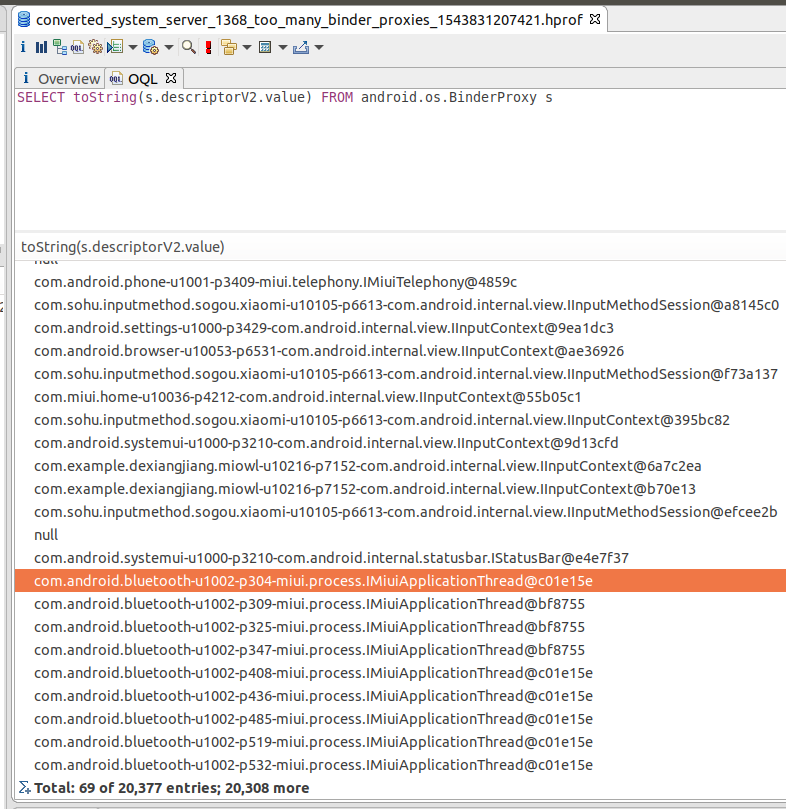
都是指向蓝牙(uid=1002)进程的BinderProxy,同时我在系统crash前也打印了system_server挂掉前的heap profile,所以接下来先借助下Eclipse MAT来统计下所有的BinderProxy

注:android上通过Debug.dumpHprofData()接口dump下来的hprof文件需要用hprof-con工具手动转一下才能由MAT打开,这个工具位于你下载的android sdk目录,见${android-sdk}/platform-tools/hprof-conv
展开所有的entry后,点击工具栏的"导出"按钮,再由shell命令排序好后,得到:
| BinderProxy | 数量 |
|---|
| android.bluetooth.IBluetoothHeadset | 6583 |
| android.bluetooth.IBluetoothHidDevice | 6518 |
| miui.process.IMiuiApplicationThread | 6048 |
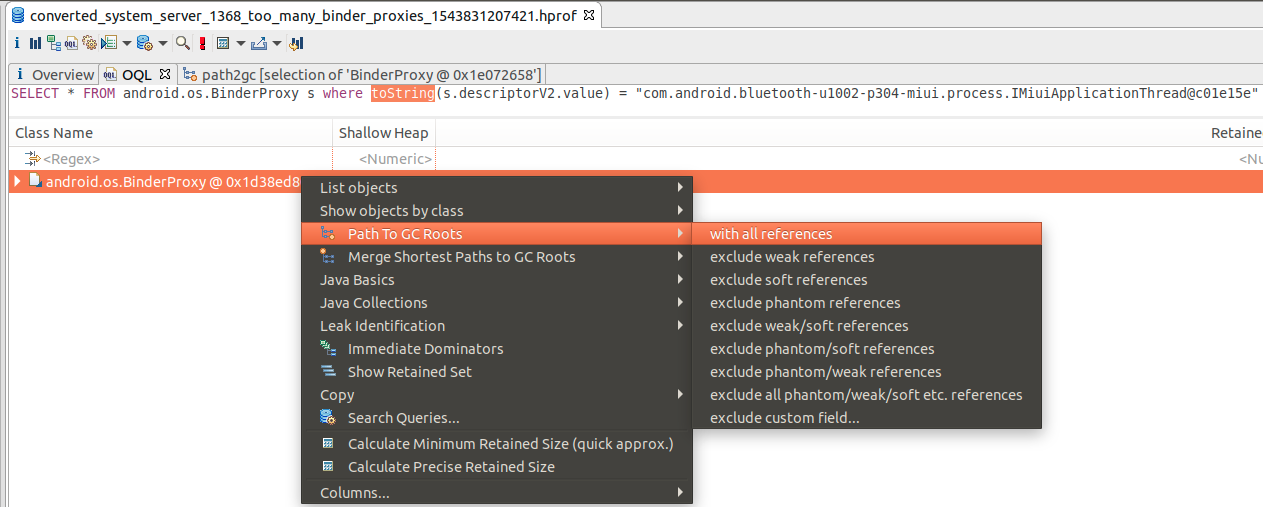
挑选一个interfaceDescriptor是蓝牙进程的IMiuiApplicationThread的BinderProxy的实例:
1
| SELECT * FROM android.os.BinderProxy s where toString(s.descriptorV2.value) = "com.android.bluetooth-u1002-p304-miui.process.IMiuiApplicationThread@c01e15e"
|
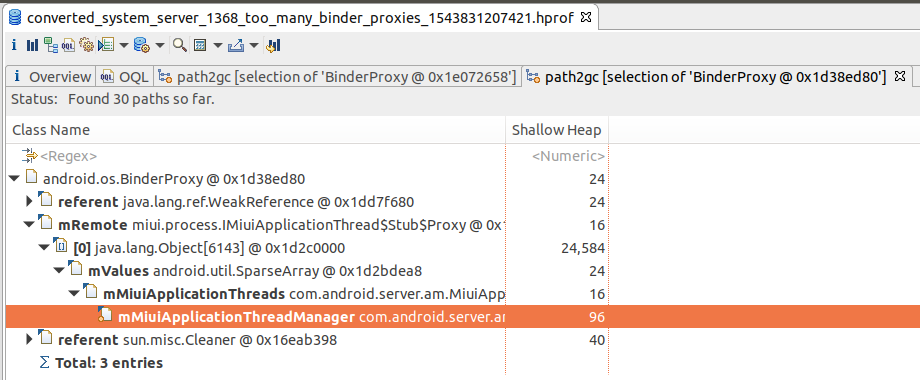
有泄漏,即它没有被虚拟机回收,那么必定就有>=1的gc 跟节点还(直接或间接)持有这个被泄露的对象的引用,所以再借助MAT来分析有哪些gc根节点指向这个被泄露的对象:
可以看到这个BinderProxy是被mMiuiApplicationThreads这个SparseArray强引用着,mMiuiApplicationThreads又是被mMiuiApplicationThreadManager引用,它是mMiuiApplicationThreadManager定义在ProcessManagerService.java里mMiuiApplicationThreads这个SparseArray的size是 6143!。
结合代码发现了每个进程的启动的时候会向system_server注册一个descriptor为IMiuiApplicationThread的BinderProxy对象,主要用于MIUI的长截屏功能而在进程挂掉的时候,却没有从移除掉,所以就发生泄漏,详细代码枯燥,此处略,这一块属于进程管理相关的,直接通知相关同学进行修复了。
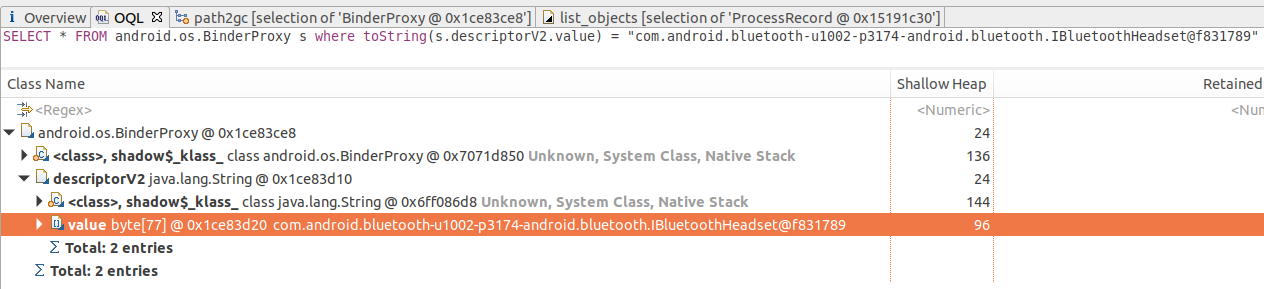
继续定位剩余两个泄漏项,流程跟定位IMiuiApplicationThread泄漏的是一样的:
1、标定一个泄漏的BinderProxy
2、查看它的gc roots
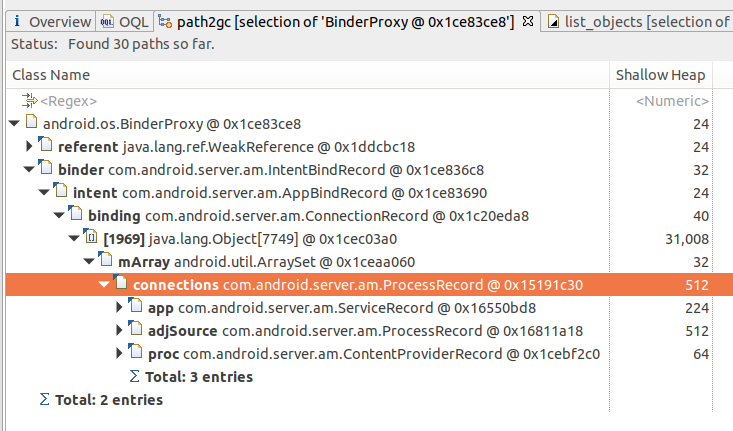
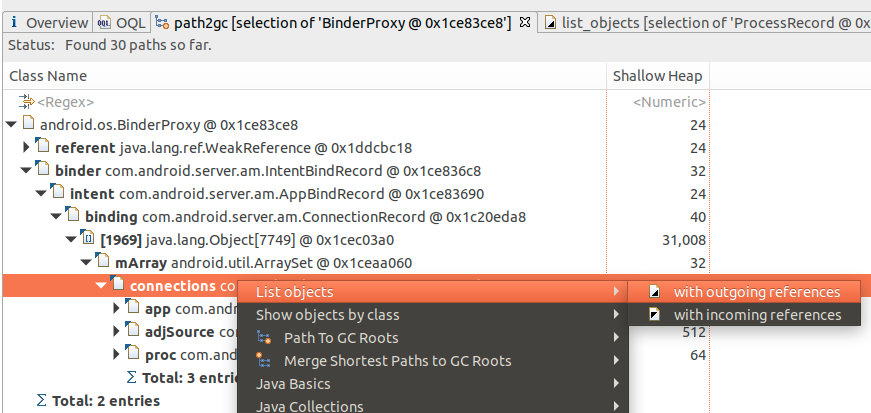
可以看到它被ProcessRecord.connections这个ArraySet引用着,那么下面再看下这个ProcessRecord是表示的哪个进程:
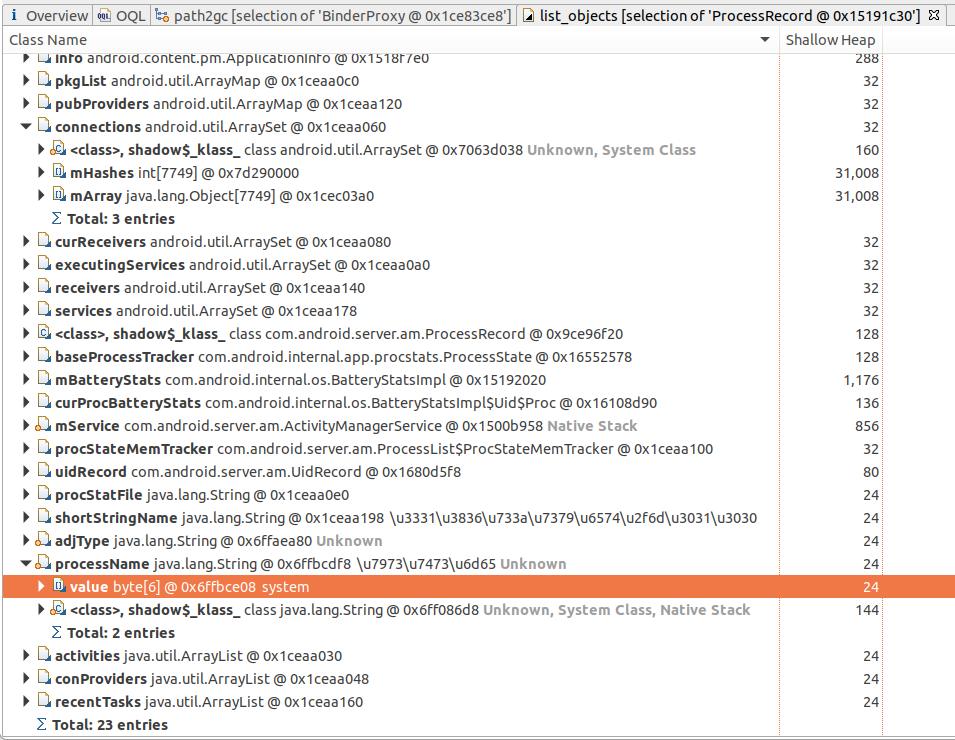
最后得到:
原来是system_server进程的ProcessRecord的问题,注意看connections.mArray的大小,有7749个!
3、确认代码逻辑:
- 翻看下对ProcessRecord.connections进行增删的地方,只有binderService和unbindService
- 到这里我们就可以判定肯定是system_server某个地方有重复绑定IBluetoothHeadset这个代表的service了,去package/apps/bluetooth目录下确认这个类是HeadsetService.java了,最终定位到BluetoothManagerService.java类里确实存在重复bind的情况,具体代码略,另外还确认到BluetoothHidDevice.java逻辑也存在问题,导致压力测试中systemui和com.xiaomi.bluetooth会出现重复bind的情况,已经跟蓝牙同事沟通,由他们进行修复并提交给aosp。
继续调查global reference overflow问题
在上面的问题都修复后,9.0上依然有global reference overflow问题,继续测试后确认是桌面频繁调用壁纸接口导致,根本原因是RemoteCallbackList.register方法实现存在问题下面这段代码可以很容易的制造出这个问题:
 1
 2
 3
 4
 5
 6
 7
 8
 9
10
11
12
13
14
15
| void testGetCurrentWallpaper() {
WallpaperManager manager = WallpaperManager.getInstance(this);
int count = 0;
while (true) {
count++;
BitmapDrawable drawable = null;
if ((drawable = (BitmapDrawable) manager.getDrawable()) == null) {
Log.d("WWW", "failed to get wallpaper: seq=" + count);
} else {
Log.d("WWW", "got wallpaper: seq=" + count);
// deprecate cahce
drawable.getBitmap().recycle();
}
}
}
|
提交了修复patch给aosp,这类小概率问题google的研发一般处理的都不会太积极
 1
 2
 3
 4
 5
 6
 7
 8
 9
10
11
12
13
14
15
16
17
18
19
20
21
22
23
24
25
26
|
    public boolean register(E callback, Object cookie) {
        synchronized (mCallbacks) {
            IBinder binder = callback.asBinder();
            try {
                Callback cb = new Callback(callback, cookie);
                binder.linkToDeath(cb, 0);
                mCallbacks.put(binder, cb);
                Callback oldDeathRecipient = mCallbacks.put(binder, cb);
                if (oldDeathRecipient != null) {
                    removeRegistration(oldDeathRecipient);
                    try {
                        // Global reference would overflow if the same callback was
                        // registered repeatedly
                        binder.unlinkToDeath(oldDeathRecipient, 0);
                    } catch (NoSuchElementException e) {
                        // Should not happen
                        Slog.d(TAG, "Failed to unregister " + oldDeathRecipient);
                    }
                }
                return true;
            } catch (RemoteException e) {
                return false;
            }
        }
    }
|
小结:
内存泄露问题,平时一般都不会太关注,如果是app开发还好点,集成一下leakcannary这类工具,可以做到自动分析activity这类泄露,基本上能把潜在的泄露在外发前就解决掉;但system_server进程有点特殊,除非发生OTA,用户手动重启手机这种情况,它是一直在后台运行的,哪怕有一点泄露,也经不住几周或几个月的累积,积累到一定程度了,就是系统卡顿,app频繁被杀,最终异常重启,影响用户口碑。